The Trust Signals AI Engines Reward Most in 2026 (And Where NZ Brands Should Invest)
Third-party citations are the only trust signal that scores highly across every major AI engine, according to 2026 research from Neil Patel's agency NP Digital.
They score 4.5 to 4.8 on all six platforms tested. Every other signal — backlinks, structured data, community engagement — varies sharply depending on which AI engine your buyer is using. This post breaks down the data and translates it into where NZ trust-sector brands should actually spend.
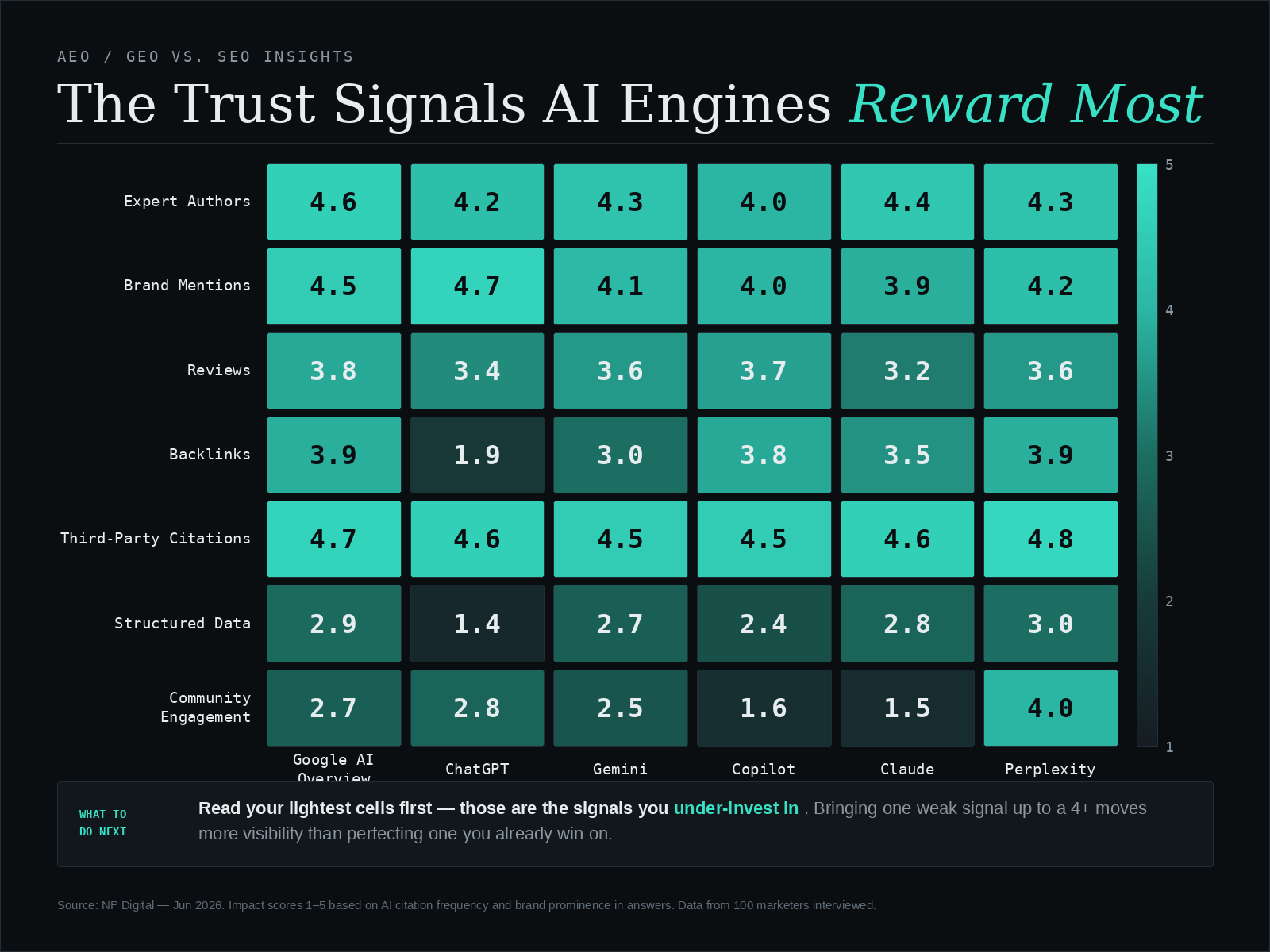
Trust signals AI Engines Reward Most
Source: NP Digital, June 2026. Impact scores 1–5 based on AI citation frequency and brand prominence, from 100 marketers interviewed.
Key takeaways
Third-party citations win everywhere. 4.5–4.8 across all six AI engines — the only universal trust signal.
Expert authorship is the reliable runner-up. 4.0–4.6 across platforms. Named, credentialed authors out-cite anonymous bylines.
Backlinks are now a Google signal, not a universal one. 3.9 on Google AI Overview vs 1.9 on ChatGPT.
Structured data is oversold for AI. As low as 1.4 on ChatGPT. Useful for Google features, weak for AI citations.
Community engagement is a Perplexity play. 4.0 on Perplexity but 1.5 on Claude — the highest-variance signal in the study.
What to do: Prioritise digital PR (third-party citations), put named experts on your best content, and match every other tactic to the AI engine your buyers actually use.
What the research measured
NP Digital interviewed 100 marketers and scored seven trust signals from 1 to 5, based on how strongly each drove citation frequency and brand prominence inside AI answers. The signals were measured across six AI engines: Google AI Overview, ChatGPT, Gemini, Copilot, Claude, and Perplexity.
What is the single most important trust signal for AI search?
Third-party citations are the single most important trust signal for AI search. They score 4.5 to 4.8 across all six AI engines - the tightest, highest band in the entire dataset. No other signal comes close to that consistency.
As Neil Patel put it: "Third-party citations do not [vary]. If you invest in one thing to build AI citation authority across all six major platforms simultaneously, earn more third-party mentions."
For NZ brands, third-party citations means earned mentions in credible external publications - trade media, industry bodies, mainstream press, respected NZ outlets. One digital PR win compounds across every AI engine at once, which makes a systematic PR programme the highest-leverage GEO investment available.
Does expert authorship affect AI citations?
Yes - expert authorship consistently lifts AI citation rates. Content tied to a named, credentialed subject-matter expert scores 4.0 to 4.6 across platforms and out-cites the same content published under a generic company byline. This is E-E-A-T (experience, expertise, authoritativeness, trust) showing up directly in AI behaviour.
Practical move for NZ teams: name your authors. A piece attributed to your head of advice or a senior consultant, with a real bio and verifiable credentials, will out-cite an anonymous "Team" byline every time.
Do backlinks still matter for AI search?
Backlinks matter for Google-based AI, but far less elsewhere. They score 3.9 on Google AI Overview and Perplexity, but just 1.9 on ChatGPT - the widest split of any traditional SEO tactic. Google AI Overview draws from Google's index, so links still carry weight there. ChatGPT's retrieval architecture largely ignores them.
The read: keep link building if Google AI Overview is your priority; deprioritise it if your buyers live in ChatGPT. Match the spend to the platform.
Is structured data (schema) worth it for AI visibility?
Structured data is oversold as an AI-visibility tactic. Schema markup scores low across the board - 1.4 on ChatGPT, topping out at 3.0 on Perplexity. It helps Google indexing and rich results but does not produce a proportional AI-citation benefit on most platforms. Keep schema for Google Search features; don't treat it as a primary lever for getting cited in AI answers.
Does community engagement (Reddit) help across all AI engines?
No - community engagement is the highest-variance signal in the study, and only pays off on some engines.
It scores 4.0 on Perplexity but just 1.6 on Copilot and 1.5 on Claude. Perplexity's retrieval weights community and discussion content heavily; Claude and Copilot barely reward it as a citation signal.
This complicates the popular "get on Reddit and every AI engine rewards you" narrative. Reddit is still where NZ buyers form opinions, and it still feeds Google - but as a direct AI-citation signal it's a targeted Perplexity play, not a universal one. (We cover the Reddit opportunity for NZ brands in depth in our companion guide - link here.)
What should NZ brands do next?
Build a systematic digital PR programme. Earned third-party mentions are the only signal that pays off everywhere. Prioritise credible NZ trade media, industry associations, and mainstream outlets over volume tactics.
Put named experts on your best content. Give senior people real bylines, bios, and credentials - and build their external profile so they're referenced elsewhere too.
Match backlink spend to your priority platform. High value if Google AI Overview matters most; low return if ChatGPT is where your buyers are.
Stop over-investing in schema as a GEO tactic. Useful for Google features, weak for AI citations. Reallocate the effort.
Treat community engagement as a Perplexity play. If Perplexity is a real referral source for your category, Reddit and forum participation is high priority; if your audience leans Claude or Copilot, it's a weaker bet for citations.
Frequently asked questions
What trust signals do AI engines reward most in 2026? Third-party citations are rewarded most consistently, scoring 4.5–4.8 across all six major AI engines in NP Digital's 2026 study. Expert authorship (4.0–4.6) is the next most reliable. Backlinks, structured data, and community engagement vary widely by platform.
How do I get my brand cited by ChatGPT, Perplexity, and Google AI Overview? Earn mentions in credible third-party publications, attribute content to named credentialed experts, and cite real sources. These are the signals that transfer across engines. Platform-specific tactics (backlinks for Google AI Overview, community content for Perplexity) can be layered on top.
Are backlinks still important for AI search? Only partly. Backlinks score 3.9 on Google AI Overview but 1.9 on ChatGPT, so their value depends heavily on which AI engine your buyers use.
Is schema markup worth it for GEO? Schema helps Google Search features but has low impact on AI citations (as low as 1.4 on ChatGPT). It should not be a primary GEO investment.
Does Reddit help with AI search? It depends on the engine. Community engagement scores 4.0 on Perplexity but 1.5 on Claude. Reddit is high-value for Perplexity and Google visibility, and still shapes buyer sentiment everywhere.
The bottom line
Read your weakest trust signals first - those are what you're under-investing in. Bringing one weak signal up to a 4+ moves more AI visibility than perfecting one you already win on. And if you invest in only one thing, make it third-party citations: it's the single move that compounds across every major AI engine at once.
Research credit: Neil Patel / NP Digital, "The Trust Signals AI Engines Reward Most Across 6 Platforms," June 2026. Analysis and NZ application by Unfold.
Related reading: AI Search Optimisation for NZ Brands (Start with Reddit).
Want to know which trust signals your brand is under-investing in?
Talk to Unfold about AI search strategy →.